Thursday, September 21, 2023

Monongya's Mastery, In One Piece

 The list of true contemporary masters in Southwest Indian silverwork is short, but any such list surely must include the name of Jesse Monongya.  Through his long and productive career, he has continually pushed the boundaries of "Indian" jewelry, both technically and in his choice of materials.  His mastery of mosaic inlay is superb, and he almost singlehandedly popularized the use of materials such as opal.  We would like to celebrate him and his jewelry by looking closely at a piece that demonstrates what is great and unique about his work--this 14k gold and inlay belt buckle.


The buckle is one of his "night sky" pieces, although different from many in that the background is blue rather than black.  Many artists have followed his lead in making "night sky" pieces, but he was the original, and his work is of exceedingly high quality.  He also used the finest materials, such as natural opal, high grade coral and natural lapis.  His use of dot inlay is not groundbreaking (Leo Poblano and Teddy Weahkee were doing it as far back as the 1930s), but the way he sometimes uses a ring of gold or silver around a colored dot is his innovation (note the red dot in the top right hand corner of the buckle with a gold ring around it.)  And, in fact, three of the red dots are actually high-quality Burmese rubies that fluoresce under UV light. 

One thing about this buckle that is different from much of his earlier work is his use of diamonds along the edges.  And not just tiny melee diamonds, either--each diamond is approximately 3/16 of a carat, so there is a total of approximately 1.5 carats of diamond in the buckle.  As is proper when setting diamonds, he left the back open to let more light through to highlight the sparkle of the stones.

What is truly unique about this buckle, though, is what is on the back:


Totally unexpected, and quite wonderful.  Note the great attention to detail, including the coral tips to the antennae of the butterfly.  Kind of an homage to Loloma and his "inner beauty" pieces with the inlay on the inside, where only the wearer knows it is there.  His hallmark is directly above the butterfly, and his last name is spelled with an A on the end, as he did in later pieces.  (We currently have a necklace he did in 1985 where it is spelled with an E on the end.)

The buckle measures 2 3/4" x 1 5/8", takes up to a 1" leather, and weighs 77 grams.  It is currently available for purchase--for more information, email us or call at (480) 423-8777.


Wednesday, February 22, 2023

Dealer Lingo: The Slang We Use

Every business has its own vernacular language, and the antique Indian art business is no different.  We as dealers sometimes assume that what we say is understandable to everyone, when in fact a little dictionary would sometimes be quite helpful.  So, as a public service, here is a listing of terms that we in the biz use that you may run into sometimes, and their real-world definitions:

Tranny--definitely not what it means in the bigger world.  A transitional blanket, woven by a Navajo weaver between 1880 and 1905.  Made from handspun wools, often in an eye-dazzler pattern.

Stoplight ring--a Navajo ring with three round turquoise, set vertically like in a stoplight.

Salt and pepper beadwork--beadwork done with a random pattern of colors, rather than in a specific pattern.

Diamond slot First Phase--an early Navajo concho belt, with a diamond shaped opening with a central bar so that the leather can be threaded through the concho.  These were made before soldering was a common practice amongst the Navajo, because after that, loops were soldered on to the back of conchos to hold the leather.

Height bracelet or ring--a bracelet or ring with stones set in differing heights.  This was a specialty of Charles Loloma, who invented the technique and used it to represent mesas and landscapes.  Not a common technique, but when done well it is very striking and beautiful.

Fishscale inlay--a Zuni technique of channel inlay where the stones are set in small, curved pieces.  The resulting effect is very much like a fishscale pattern.

Sawtooth bezel--a silver bezel with hand-cut serrations resembling the teeth of a saw blade.  Normally found in early (pre-1930) Navajo silverwork.

Heavy Harvey jewelry--tourist-trade oriented jewelry that is heavier than the usual very thin, badly made jewelry that was sold to tourists before 1940.  Unlike much tourist trade jewelry, Heavy Harvey pieces are hand-made, and often incorporate good turquoise.

Windowpane earrings--early (usually) earrings where a turquoise tab is edge-wrapped in silver to produce a windowpane effect on both sides. 

Blank--a commercially made casting mold, often used in lower-end jewelry to produce cast pieces.  Pieces made from blanks will be even and precise and will show up multiple times.  Pieces from hand-carved casting molds will show the slight imperfections of all hand-made things and will often be totally unique.

Shiprock Yei--a Navajo weaving with a white background, incorporating Yei holy figures and often cornplants.  Most were woven in the Four Corners region, an area dominated by Shiprock.

Crow pink--a shade of pink beads that was especially favored in the work of the Crow people.

Cutter--a Navajo weaving that is so damaged that its only use is to be cut up and used for pillows or in jacket inserts.

Resto--short for restoration.

Beader--a piece of beadwork that is damaged beyond repair and is normally used as a "bead mine" to fix other pieces.

Whitehearts--early red beads with a white center.

Dance bead--a bead, usually turquoise, that has been attached to a necklace to show that it has been worn in a dance or ceremony.

Burn--as in, "to burn a piece".  That is, to expose a piece to the market at an unrealistic high price.  A pet peeve of reputable dealers.

That is all for now, but we will rack our brains searching for other entries.  If you know of any that we have neglected, please let us know!


Thursday, June 9, 2022

Things that look like things in books

Anyone who has seen our library of Native American Art books knows that we practice what we preach in that regard; it is not easy to find a book on the subject that is not represented.  And since art books tend to have lots of pictures, it is not uncommon for us to find a piece in our inventory in one of them, or else something very close to it.  Sometimes it is a known fact, while other times it comes as a pleasant surprise, but either way, it is always nice to know that someone thought enough of a piece similar to (or identical to) yours to include it in a book, immortalized for eternity.  And occasionally, the book will teach you something about the piece that you did not previously know, which is the best of all worlds.

(A bit of terminology here--calling something a "book piece" means that that exact piece was published in a book.  That is different from having a piece that is very similar to a piece in a book.)

A necklace that meets all the criteria as a book piece is this one pictured below:


It is pictured as lot #1015 on page 169 of the C. G. Wallace Auction Catalog of 1975, which places it in time at that point.  Additionally, it is dated to 1928 in the book, and attributed to Leekya Deyuse by the man who originally collected it.  The best book pieces have this kind of ironclad provenance, which is one reason why they always command a premium on the open market.

Now, what about similar pieces?  That is, pieces that are similar to book pieces, but not the same?  There is still a lot to be learned from comparing similar pieces.  Sometimes, you can even make an attribution, though that can be dangerous if you have not seen the book piece in person.  Take this bracelet:


A very unusual bracelet, with silver balls surrounding turquoise that is set in sawtooth bezels.  Now, look at this book piece from WATER WIND BREATH, the new book on the Southwest American Indian collection at the Barnes Foundation in Philadelphia:


At first glance, they look to have been made by the same hand.  Serrated bezels, silver drops surrounding the stones, and what appears to be wirework in the background.  But on closer examination, the Barnes Foundation bracelet is a solid piece of silver, with filework done to resemble wirework.  Also, the turquoise and silver balls in the book piece are set directly on the bracelet, while our bracelet has the stones and silver balls set on plates that are then attached to the bracelet.  Small differences, but important ones.  Can it be said that the two were made by the same maker?  It is possible, but it can't be said without a shadow of a doubt.

And then, there are pieces that pass the test.  Here is a fantastic silver bracelet:


And here is a picture from the book LOLOMA:


Not hard to say that all three pieces are by the same hand, certainly.  And in fact, they are all hallmarked by the maker, Charles Loloma, so we already knew that.  What we can learn from the book is that these bracelets were the first ones he did in the Kachina Face pattern, which was one of his greatest artistic expressions in jewelry.  That was in 1981, so the huge similarities make it possible for us to date our Loloma Kachina Face bracelet with a great degree of accuracy.  All because it is similar to a book piece.

The Leekya necklace and the two bracelets mentioned here are all available for purchase.  If you have any questions about any of them, please feel free to email or call us at 480-423-8777.


Thursday, May 5, 2022

A comparison of two great old bracelets

One of the hardest things to do with antique Indian jewelry, as with all antiques, is to establish fair value.  Big things make a big difference, certainly (age, condition, provenance, overall quality) but little things can also make a big difference.  What separates a more expensive piece from its less expensive cousin, when most of the factors are equivalent or nearly so?  To answer this question in one small example, let's look at two bracelets in Turkey Mountain's current inventory.


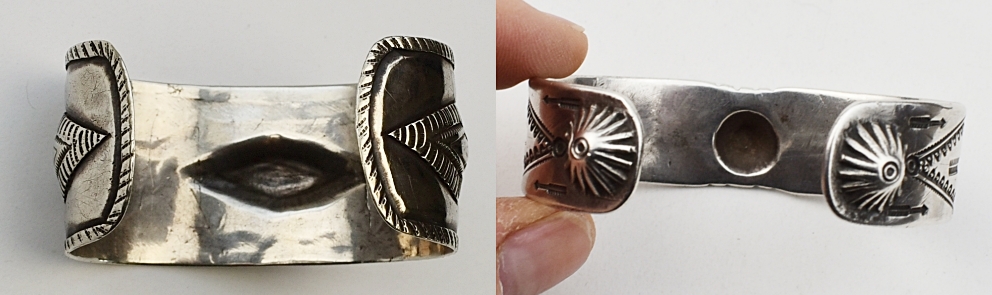
On the left is B 3267, and on the right is B 3297.  Both are Navajo silver bracelets, and both predate 1915.  Condition on both is excellent, and many of the construction details are similar.  B 3267 has an inside size of 5 3/4", while B 3297 has an inside size of 5 5/8".  Yet B 3267 is priced at $4900, while B 3297 is at $3600.  Why the difference?

The first two reasons are obvious.  3267 on the left is wider and larger scale, with more silver.  It weighs 49 grams, while the other weighs 40 grams.  Also, 3267 has a turquoise set in the middle, and bracelets with turquoise will normally sell for more than similar ones without.  Those are the factors that anyone can see.  Now, let's look at some factors that are not so obvious.


On the sides, B 3267 has repoussed and filed diamonds, while the diamonds on the sides of B 3297 are merely stamped.  Repousse is a very difficult and technically demanding technique, so pieces that show repousse command a premium.  However, B 3297 is not totally defenseless--it has repoussed terminals, and any kind of interesting terminal treatment, be it repousse or set stones, makes a piece quite desirable.  So, both pieces show very fine and interesting repousse work, though in different places.


And now we see more repousse, this time in the center of the bracelet.  Both bracelets have it--on B 3267 on the left, the repousse is beneath the turquoise, while there is no turquoise on the repousse on B 3297 on the right.  However, if you look closely, you will notice that the inside of the repousse on both bracelets is smooth, while the outside shows either concentric diamonds (on the left) or fluting (on the right).  This means that the artist in both cases filed the outside of the repousse to create texture and design.  Since the filework was only done on the outside, the inside remains smooth.  A very difficult and demanding way to decorate silver, and both bracelets have it.

The stampwork on B 3297 on the right is a bit more finely done than that of B 3267 on the left, including all those wonderfully executed arrows.  This means that B 3297 is likely just a touch younger than B 3267--not much, maybe 5 or 10 years.

One last factor is provenance.  B 3267 has been in two very important collections in its lifetime--the Laura Anderson and Phil Bacon collections.  B 3297 is still waiting to be a part of an important collection, which it certainly deserves.  

So, to conclude, B 3267 on the left is wider, heavier, older, and has turquoise and better provenance.  B 3297 on the right is more finely done, and still shows great age and wear.  The extra age on B 3267 is what mostly accounts for the price difference, but being narrower, B 3297 might be easier for everyday wear.  Also, the terminal repousses on B 3297 are absolutely fantastic.  In the end, the main deciding factor should be which bracelet appeals more to you.  They are both fantastic pieces worthy of being in any collection.

For more information on these pieces, or any others in our inventory, email us or call 480-423-8777.


Thursday, March 24, 2022

The Arctic Worlds of Denise Wallace

One of the most creative and collectible Native artists that TMT carries is Denise Wallace, a Chugach Aleut woman who, by herself and in collaboration with her late husband Samuel, has created some of the most amazing jewelry of the modern era.  Her work always tells a story, with each piece titled and representing a facet of Alaskan Native culture.  Many of those reading this will be familiar with her work, but for those who are not, this blog entry will be a visual treat.

Sea Otter pin/pendant,1990, #14/20 (face is closed)

(face is open)

Wallace works mostly in silver, though gold accents are not uncommon.  She is known for using fossil ivory inlays, which as a member of an indigenous Alaskan group she can do legally.  One of the trademarks of her work is masks that open to reveal something underneath, usually a face.

Woman in Moon pin/pendant, 1988 (closed)
(open)

All of the designs are all Denise's, and up until Samuel's death in 2010, much of the fabrication was done him, an extremely talented craftsman.  Since that time, Denise has continued on creating and fabricating her own designs.  Since Samuel was not Native American, for years Denise was not allowed to exhibit at Indian Market, but she currently is an active participant and prizewinner. 

Seal Hunt ring, 1990

Most of the pieces Denise has made are multiples, with the sea otter above being number 14 of an edition of 20.  Smaller pieces such as the Woman in the Moon and Seal Hunt pieces above are larger editions, and not individually marked as such.  

Dancer Bracelet, 3/3, 1990 (closed)

(open)

More major pieces, like the Dancer bracelet above, are done in smaller editions (in this case, only 3).  This bracelet shows Wallace's use of different stones, in this case lapis, alongside the familiar fossil ivory.  

Fish earrings, undated

For those on a slightly more limited budget, Wallace also has created what she calls Gallery Line pieces, which are cast pieces with hand-executed elements added on, like the carving on the fish earrings above.  Most were done in Santa Fe between 1992 and 1997, after which the Gallery Line was discontinued.

Of her work, Denise has said, "My main goal is, through my work, to express Alaska Native culture."  

A very comprehensive book on Wallace's career was written and published by Lois Sherr Dubin in 2005, and shows many other great examples of her work.  It is called ARCTIC TRANSFORMATIONS: THE JEWELRY OF DENISE & SAMUEL WALLACE, and is available on Amazon.

All the pieces illustrated here are available for purchase--for more information, contact us at (480) 423-8777. 


Monday, January 10, 2022

Lots of Leekya

For many people, Leekya Deyuse (commonly known as Leekya) is the first, last and only word in historic Zuni fetish carving.  Many contemporary carvers exhibit amazing artistry and technical proficiency, but it cannot be denied that Leekya took the Zuni art of stonecarving to a place it had never seen before, turning it from a craft into a true art form.  By the time he died in 1966, his work was universally acknowledged as the finest and most distinct ever made at the Pueblo.  Today, collectors and museums actively seek out his work, which is both rare and valuable.

There was a real paucity of information in the literature about him until 2018, when in conjunction with a show at the Albuquerque Museum, Deb Slaney published her book LEEKYA: MASTER CARVER OF ZUNI PUEBLO.  It is the finest work done to date on him (and some of his compatriots and descendants) and is a must-have for anyone serious about Southwest Indian arts.  (To obtain a copy of the book, contact the Albuquerque Museum directly.)  In celebration of the book and the artist, we are pleased to show some of his carvings, and even more pleased to share some of our knowledge about the man and his art.  (All of the items pictured are from our Turkey Mountain Traders inventory and are available for purchase.  Please contact us for more details 480-423-8777.)

First off, his career as a carver started in the mid-1920s.  The necklace below is listed in the C. G. Wallace Collection catalog as lot #1015, carved in 1928.  It is hardly the work of a newcomer to the art, as you can see.


The form most commonly associated with Leekya is the bear, and he had a very specific way of carving the ears that differentiates his work from imitators.  In the words of Deb Slaney, "Tom and Deborah Begner of Turkey Mountain Traders noticed in the 1990s that Leekya's bears' right ears were often carved vertically while the left ears were angled, suggesting a patter to Leekya's carving method; that is, which hand holds the animal and which hand carves the details."  This observation was confirmed by Leekya's son Freddie.  Since the world is full of bears that kind of look like Leekya pieces, it is an excellent way to tell a fake from the real article.


His animals often have smiling heads tilted to one side, because he thought that smiling animals would sell better.  These small bears have slight smiles and heads cocked slightly to the side.  The white bear is exactly 1 inch long and the turquoise bear is 3/4" long--quite small for standalone Leekya carvings.


And here is another bear, this one carved in profile and set into a silver ring.  Talk about charming--the smile on this one is easily seen.

Leekya's favorite carving material, even more than turquoise, was Zuni rock, a tan-brown type of mudstone.  We don't have any of those pieces in inventory right now, unfortunately, but we have this marvelous horse carved from red abalone shell.  Note how it is carved to highlight the red on one side only.


Often, when he was carving something to be set in silver, either in jewelry or on a flat surface like a box lid, he would incorporate a pedestal base so that the carving could be more easily set.  Here are two bracelets with turquoise frogs that show this type of carving and setting (he was not a silversmith, and someone else always did the settings.)


And here is an example where he carved a very large fetish (a "bearskin rug" carving, one of two known) which was then set on a large silver box.  This carving was purportedly done in 1955, which is considered to be one of his most creative periods.


Again, in this carving he takes great advantage of the natural shading of the red abalone.  The other known "bearskin rug", which is smaller, is in the Heard Museum and pictured on page 46 of Slaney's Leekya book referenced above.

Most of Leekya's carvings were made completely by hand, though later in life he did use an electric grinder.  

If you have any questions about Leekya or any of the pieces you see here, please let us know.  And by all means, make sure you have a copy of Deb Slaney's book in your library.

Sunday, August 1, 2021

A Final Word on August Shows, and Another Reason to Come to Santa Fe

 Here we are in August, and our show schedule has been finalized.  There is no mask mandate in Santa Fe at the moment, and things are looking pretty good here.  So, here is the schedule:

Whitehawk Show:

OPENING NIGHT PREVIEW
Friday, August 13th
6pm – 9pm
Tickets $50.00 per person

THE SHOW
Saturday, Aug. 14th – Monday, Aug. 16th
10am – 5pm Daily
Tickets $15.00 per day or $25.00 for Run of Show

One thing that is different this year is that there is no dinner associated with the opening night preview, which is really too bad.  But still, it is a great opportunity to get a look at the show before the regular crowd arrives.  Turkey Mountain Traders will be in a new and bigger booth this year, directly to the left of the front door as you enter.  Our selection of jewelry, textiles and other surprises is as strong this year as it has ever been, so please check us out!

Native Treasures Show at the Eldorado Hotel:

Thursday, August 19th to Sunday, August 22nd, 8 a.m. to 5 p.m.

For those who have not been to this show, it is definitely a must-see.  And the price is right, since admittance is free!  The show is indoors and air-conditioned, which makes it a very pleasant place to be on some of those hot August days.  The show is slanted towards jewelry, though there are plenty of other works of art to be found there.  Our booth is in the back right-hand corner, the same place we were in 2019.

If you arrive in town before Whitehawk and would like a private showing, Turkey Mountain Traders is available for private appointments on the 10th and 11th at our townhouse, located a short drive from the Plaza.  Call us at (480) 423-8777 or (602) 819-5758 for your appointment.

ANOTHER REASON TO VISIT SANTA FE

For those of us who love old Native American silverwork, there is a great new exhibition at the Museum of Indian Arts and Culture (MIAC) on Museum Hill.  It is a collection of silverwork, mostly Navajo, that was purchased by former curator H. P. Mera on a trip through Indian Country in 1932.  Everything dates prior to 1932  (obviously) and it is fascinating to examine the various techniques and styles that were being used at the time.  For example, the amount of commercial silver for bezels that was available at the time was much greater than many people currently think, and Persian turquoise was also more heavily used in the 1920s than we thought.  All in all, some extraordinary pieces with fantastic provenance.  No catalog, unfortunately.  The show is well worth a special trip up the hill to MIAC when you are in town, both for the beauty of the pieces and the information they can offer.