Sunday, October 28, 2018
When is a pictorial not a pictorial?
From the time I started in the business, around 137 years ago (or so it seems), I have been fascinated by the pictorial weavings of the Navajo. So much so, in fact, that when Tyrone Campbell asked me to help with the second edition of his seminal NAVAJO PICTORIAL WEAVING 1880-1950, I jumped at the chance. Now that the book it out, and getting good reviews from all our friends and relatives, I just have one thing to add to anyone who would care to listen: A WEAVING WITH LITTLE PICTORIAL ELEMENTS DOES NOT REALLY QUALIFY AS A PICTORIAL.
Hear me out.
To be a true pictorial, a weaving must have a pictorial design that serves as the central or most important element of the visual field. Does a Ganado with two little bow and arrow designs in the center qualify? To me, no. But does this qualify?
To me, darn tootin' it does, because while the cows are not the largest part of the design, they visually dominate the landscape of the weaving. Now, compare it to this one:This one has pictorial elements, but they do not dominate like the cows in the first weaving. Therefore, it is a rug with pictorial elements, not a pictorial rug. A fine distinction, maybe, but an important one.
Tuesday, May 15, 2018
The Magic of Indigo
For those of you who love old American Indian textiles, both Navajo and Pueblo, there are two words that are absolute magic. The first is bayeta, which is a word for another day. The second is indigo, that most beautiful of all blues. (Not purple, mind you--that is another dye entirely.) But besides giving a pure and gorgeous blue, why are blankets with indigo so highly prized? Why do two nearly identical blankets sell for such different prices, with the one with indigo worth up to ten times that of its non-indigo cousin?
The first reason is pure beauty--there is no synthetic blue dye that can match the richness and depth of a good indigo blue. Also, unlike synthetic dyes that can fade quite easily, indigo dyes are not "fugitive" and will only fade under the most extreme conditions. It is not unusual to find a blanket where every color shows serious fade except the indigo blue, which remains vibrant and deep.
The second reason is both historic and economic--for many years, indigo was the only blue dye available to the Indians of the Southwest. Since it had to be brought to the reservation, often from overseas, it was extremely expensive, and normally only used by the best weavers. It was also very difficult to work with, especially considering urine was used as a mordant to fix the dye--disgusting, but necessary. Put it all together, and it was a serious enterprise to use indigo in a blanket, and it normally only appears as a highlight. I have never seen a blanket woven with an indigo blue field, for example. When synthetic dyes were introduced in quantity in the early 1880s, indigo fell completely out of favor. After all, very few people liked the idea of keeping a bucket of urine around to use with their dye.
Notice that I have never said anything about rugs with indigo dye--in twenty-five years, I have only seen one, which must have been a special order. The rug era of Navajo weaving came after the decline of indigo use, when synthetic blues were readily available. As for Pueblo weaving, it had declined to a great degree long before that time.
Collectors love indigo pieces because they represent an older and "more pure" era of weaving, when blankets were woven for native use and trade rather than purely for sale. That is the magic of indigo, in history as well as in beauty.
Monday, April 9, 2018
Wednesday, October 11, 2017
A very rare bracelet, one for the scholars
Every once in a great while, we come upon a piece so rare and interesting that we post it on our blog here, even if (like this one) it is not for sale. The last time we did this was with a dated silver bracelet--very interesting and informative for true students of the art and history of Southwestern Indian silverwork. This piece does not have a firm date like this one, but it has a feature that is so rare we wanted everyone to see it.
Here is the front view: A very nice piece, with a good old turquoise on a stamped plate. The band is split, rather than being wires soldered together--much more technically challenging. And the side view: You can better see the splits in the single silver band. A very fine old bracelet, circa 1915, but not an earthshaker just yet. But what is that at the end? Terminal stones? Now we're getting somewhere. And here is where it gets very interesting: Two rough-cut stones inside old sawtooth bezels. Very interesting indeed. Not unheard of, certainly, but quite interesting. But here is where my photography fails me--if I could get close enough and put a bright enough light on those stones, the picture would show a red glow. Because there are not turquoise, but rather garnets--known to exist in old Navajo jewelry, but incredibly rare. This is the first and only time we have ever seen garnets set on an old bracelet as terminal stones. They are very rough looking, because these are naturally occurring river garnets, rather than mined garnets--garnets can be found in streambeds in the Southwest, and tend to be darker and rougher in appearance than their cousins that come from mines.
Anyone else out there ever seen anything like this? If so, please let us know.
Here is the front view: A very nice piece, with a good old turquoise on a stamped plate. The band is split, rather than being wires soldered together--much more technically challenging. And the side view: You can better see the splits in the single silver band. A very fine old bracelet, circa 1915, but not an earthshaker just yet. But what is that at the end? Terminal stones? Now we're getting somewhere. And here is where it gets very interesting: Two rough-cut stones inside old sawtooth bezels. Very interesting indeed. Not unheard of, certainly, but quite interesting. But here is where my photography fails me--if I could get close enough and put a bright enough light on those stones, the picture would show a red glow. Because there are not turquoise, but rather garnets--known to exist in old Navajo jewelry, but incredibly rare. This is the first and only time we have ever seen garnets set on an old bracelet as terminal stones. They are very rough looking, because these are naturally occurring river garnets, rather than mined garnets--garnets can be found in streambeds in the Southwest, and tend to be darker and rougher in appearance than their cousins that come from mines.
Anyone else out there ever seen anything like this? If so, please let us know.
Tuesday, September 26, 2017
A memory of the past, in memory of Marti Struever
Back in 1992, when I was a young pup of (your guess here) years, I had a job with the Crow Canyon Archaeological Center in Cortez, Colorado. Being somewhat young and able to carry large quantities of luggage, as well as the proud possessor of a valid drivers' license, my job was to plan and staff trips throughout the Southwest, where we would visit archaeological and cultural areas of interest. To put it bluntly, I was a glorified van driver, but a van driver who had to know a whole bunch about the Indian Southwest, its people and its history. So, a highly educated van driver. Those of you who know me will be nodding vigorously and saying, "Sounds perfect. Just throw in that he needed to eat Cheetos while he drove, and it would be the ideal job." I didn't have to eat Cheetos, actually. I could eat Doritos if I wanted to--but I digress.
One day, during a staff meeting, I was told that I was going to be a driver on a trip called Art and Archaeology, which differed from most of our archaeologically based trips in that the main focus was on visiting living artists at their homes and studios. The main attraction to me was that after months of living on minimum wage, I would get to spend three days in Santa Fe with a Crow Canyon expense account and eat well; a close second was meeting up close and personal with some of the artist whose work I had only seen in books. The trip would be led by a woman named Martha Struever, whom everyone called Marti. She was married to the president of Crow Canyon, and was supposedly one of the big experts in this kind of thing. Sounded good--good art with a knowledgeable guide, and meals that didn't come in a Styrofoam box. A dream gig for me. But then came the kicker: my boss told me that the trip leader, this Marti, had a heart condition and was in delicate health. So, the main part of my job would be to carry all her luggage and make sure she didn't die. Yippee. I could just see it--the company president's wife, who also happened to be a big shot in a major industry in the Southwest, dies on my watch and I don't ever work in the Four Corners again.
It was with more than a little bit of trepidation that I waited at the gate for Marti's airplane to arrive (back when you could still wait at the gate.) Since we had never met, I hoped that my Crow Canyon t-shirt would be enough for her to recognize me, though from what my boss had said I was sure I would recognize her y her wheelchair. Imagine how surprised I was when an impeccably dressed woman strode briskly up to me and introduced herself as Marti, then left me in her wake on the way to gather her luggage (which, by the way, was just as bulky and numerous as I had feared.) Not what I had expected at all--hardly an invalid, though her health form on file at the office had clearly stated her heart trouble.
Over the next week, I was constantly amazed by her knowledge, her energy and her huge circle of friends and colleagues in the Southwest. We zipped from place to place, from Hopi to Kayenta to Farmington to Santa Fe, stopping along the way to meet artists and dealers who all seemed to know Marti as well as their own families. And her delicate heart? No problems at all, partly because I was the one lugging her giant suitcases throughout all of the Four Corners states. In later years, when I got to know Marti as a colleague and friend, I often thought of asking her if she had brought along extra stuff because she knew someone else would be carrying it, though I never did. But I did often remind her of her "delicate" condition on that trip, and we had a good laugh about it.
We got the news this morning that Marti had passed away, and were saddened to hear it. But we, as everyone else who knew her, should be glad that she lived her life the way we all should--doing what we love with interesting and talented people at our side, even if they are only talented at eating Cheetos and driving a van. And carrying heavy luggage. Thank you for everything, Marti, and rest in peace.
One day, during a staff meeting, I was told that I was going to be a driver on a trip called Art and Archaeology, which differed from most of our archaeologically based trips in that the main focus was on visiting living artists at their homes and studios. The main attraction to me was that after months of living on minimum wage, I would get to spend three days in Santa Fe with a Crow Canyon expense account and eat well; a close second was meeting up close and personal with some of the artist whose work I had only seen in books. The trip would be led by a woman named Martha Struever, whom everyone called Marti. She was married to the president of Crow Canyon, and was supposedly one of the big experts in this kind of thing. Sounded good--good art with a knowledgeable guide, and meals that didn't come in a Styrofoam box. A dream gig for me. But then came the kicker: my boss told me that the trip leader, this Marti, had a heart condition and was in delicate health. So, the main part of my job would be to carry all her luggage and make sure she didn't die. Yippee. I could just see it--the company president's wife, who also happened to be a big shot in a major industry in the Southwest, dies on my watch and I don't ever work in the Four Corners again.
It was with more than a little bit of trepidation that I waited at the gate for Marti's airplane to arrive (back when you could still wait at the gate.) Since we had never met, I hoped that my Crow Canyon t-shirt would be enough for her to recognize me, though from what my boss had said I was sure I would recognize her y her wheelchair. Imagine how surprised I was when an impeccably dressed woman strode briskly up to me and introduced herself as Marti, then left me in her wake on the way to gather her luggage (which, by the way, was just as bulky and numerous as I had feared.) Not what I had expected at all--hardly an invalid, though her health form on file at the office had clearly stated her heart trouble.
Over the next week, I was constantly amazed by her knowledge, her energy and her huge circle of friends and colleagues in the Southwest. We zipped from place to place, from Hopi to Kayenta to Farmington to Santa Fe, stopping along the way to meet artists and dealers who all seemed to know Marti as well as their own families. And her delicate heart? No problems at all, partly because I was the one lugging her giant suitcases throughout all of the Four Corners states. In later years, when I got to know Marti as a colleague and friend, I often thought of asking her if she had brought along extra stuff because she knew someone else would be carrying it, though I never did. But I did often remind her of her "delicate" condition on that trip, and we had a good laugh about it.
We got the news this morning that Marti had passed away, and were saddened to hear it. But we, as everyone else who knew her, should be glad that she lived her life the way we all should--doing what we love with interesting and talented people at our side, even if they are only talented at eating Cheetos and driving a van. And carrying heavy luggage. Thank you for everything, Marti, and rest in peace.
Tuesday, September 19, 2017
In Praise of the Humble Bezel
When looking at the kind of jewelry we all love, historic American Indian silverwork, it would be hard to overstate the importance of the bezel in dating a piece. Bezels, which are technically silver strips wrapped around a stone to hold it in place on a silver base, have changed quite a bit over time, as the tools, materials and techniques available to silversmiths have become more and more advanced.
Early on, the big problem facing Indian silversmiths was how to encircle a stone at an angle without folding the thin silver of the bezel. (Imagine wrapping a strip of paper around an orange without there being gaps or folds--try it sometime! It is basically impossible.) To solve this problem, early smiths would usually crimp or notch the silver, which looked something like this (circa 1900):
Later, some smiths would notch the silver all the way around the stone, creating what we call a sawtooth bezel (circa 1915).
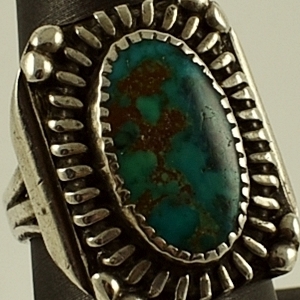
As you can see, this neatly solved the problem of having the thin silver fold over or form gaps. And the visual effect was quite interesting, so much so that some smiths continued to use the sawtooth bezel well into the 1940s, after it was no longer necessary. Here is a ring with a sawtooth bezel from the 1930s.
To make a smooth bezel before 1920 was a real challenge, but could be done if the stone had a high dome and the silver was left somewhat thick. Here is an example from circa 1915:
You can see that the bezels are not perfectly smooth, but considering the early date, the smith did as good a job as he possibly could have managed.
By 1935, the introduction of commercially made bezels had made smooth bezels possible, though it would be some time before smiths in the Southwest were universally able to manipulate them with near-perfect dexterity. Here is a ring with what are probably early commercial bezels--note that they are not perfectly done (circa 1925-30):
And finally, when the use of commercial bezels became the rule rather than the exception, a smooth bezel that was just about perfect was not only possible, but commonplace. Here is an example by Fred Peshlakai from circa 1950:
The moral of the story is, know your bezels. They can be your best friend in dating older Southwest Indian silverwork.
Early on, the big problem facing Indian silversmiths was how to encircle a stone at an angle without folding the thin silver of the bezel. (Imagine wrapping a strip of paper around an orange without there being gaps or folds--try it sometime! It is basically impossible.) To solve this problem, early smiths would usually crimp or notch the silver, which looked something like this (circa 1900):
Later, some smiths would notch the silver all the way around the stone, creating what we call a sawtooth bezel (circa 1915).
As you can see, this neatly solved the problem of having the thin silver fold over or form gaps. And the visual effect was quite interesting, so much so that some smiths continued to use the sawtooth bezel well into the 1940s, after it was no longer necessary. Here is a ring with a sawtooth bezel from the 1930s.
To make a smooth bezel before 1920 was a real challenge, but could be done if the stone had a high dome and the silver was left somewhat thick. Here is an example from circa 1915:
You can see that the bezels are not perfectly smooth, but considering the early date, the smith did as good a job as he possibly could have managed.
By 1935, the introduction of commercially made bezels had made smooth bezels possible, though it would be some time before smiths in the Southwest were universally able to manipulate them with near-perfect dexterity. Here is a ring with what are probably early commercial bezels--note that they are not perfectly done (circa 1925-30):
And finally, when the use of commercial bezels became the rule rather than the exception, a smooth bezel that was just about perfect was not only possible, but commonplace. Here is an example by Fred Peshlakai from circa 1950:
The moral of the story is, know your bezels. They can be your best friend in dating older Southwest Indian silverwork.
Friday, July 14, 2017
Another Santa Fe show? Really?
Some of you may have noticed that Turkey Mountain Traders has a new show on the schedule for Santa Fe. This one is the Objects of Art show, which runs from August 10-13. The obvious question is why we need another show, since we already do our private condo show, the Antique Indian Show and the show at the Eldorado Hotel during Indian Market. The answer is that we will not be showing the same material at the Objects show--while the other shows will have our selection of jewelry, textiles and beadwork, the Objects show will feature a special Midwest collection of folk art and Mexicana--pottery, santos, ex votos, bateas, lacquerware and many other wonderful surprises.
Come see us at all the shows!
Subscribe to:
Posts (Atom)