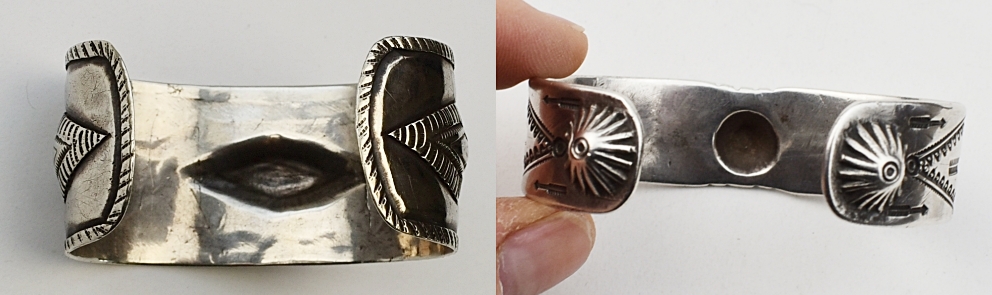
One of the hardest things to do with antique Indian jewelry, as with all antiques, is to establish fair value. Big things make a big difference, certainly (age, condition, provenance, overall quality) but little things can also make a big difference. What separates a more expensive piece from its less expensive cousin, when most of the factors are equivalent or nearly so? To answer this question in one small example, let's look at two bracelets in Turkey Mountain's current inventory.
Thursday, May 5, 2022
A comparison of two great old bracelets
Thursday, March 24, 2022
The Arctic Worlds of Denise Wallace
One of the most creative and collectible Native artists that TMT carries is Denise Wallace, a Chugach Aleut woman who, by herself and in collaboration with her late husband Samuel, has created some of the most amazing jewelry of the modern era. Her work always tells a story, with each piece titled and representing a facet of Alaskan Native culture. Many of those reading this will be familiar with her work, but for those who are not, this blog entry will be a visual treat.
Monday, January 10, 2022
Lots of Leekya
For many people, Leekya Deyuse (commonly known as Leekya) is the first, last and only word in historic Zuni fetish carving. Many contemporary carvers exhibit amazing artistry and technical proficiency, but it cannot be denied that Leekya took the Zuni art of stonecarving to a place it had never seen before, turning it from a craft into a true art form. By the time he died in 1966, his work was universally acknowledged as the finest and most distinct ever made at the Pueblo. Today, collectors and museums actively seek out his work, which is both rare and valuable.
There was a real paucity of information in the literature about him until 2018, when in conjunction with a show at the Albuquerque Museum, Deb Slaney published her book LEEKYA: MASTER CARVER OF ZUNI PUEBLO. It is the finest work done to date on him (and some of his compatriots and descendants) and is a must-have for anyone serious about Southwest Indian arts. (To obtain a copy of the book, contact the Albuquerque Museum directly.) In celebration of the book and the artist, we are pleased to show some of his carvings, and even more pleased to share some of our knowledge about the man and his art. (All of the items pictured are from our Turkey Mountain Traders inventory and are available for purchase. Please contact us for more details 480-423-8777.)
First off, his career as a carver started in the mid-1920s. The necklace below is listed in the C. G. Wallace Collection catalog as lot #1015, carved in 1928. It is hardly the work of a newcomer to the art, as you can see.
Leekya's favorite carving material, even more than turquoise, was Zuni rock, a tan-brown type of mudstone. We don't have any of those pieces in inventory right now, unfortunately, but we have this marvelous horse carved from red abalone shell. Note how it is carved to highlight the red on one side only.
Sunday, August 1, 2021
A Final Word on August Shows, and Another Reason to Come to Santa Fe
Here we are in August, and our show schedule has been finalized. There is no mask mandate in Santa Fe at the moment, and things are looking pretty good here. So, here is the schedule:
Whitehawk Show:
OPENING NIGHT PREVIEW
Friday, August 13th
6pm – 9pm
Tickets $50.00 per person
THE SHOW
Saturday, Aug. 14th – Monday, Aug. 16th
10am – 5pm Daily
Tickets $15.00 per day or $25.00 for Run of Show
Friday, May 14, 2021
The (current) word on our August shows
One of the big questions running around our part of the world lately has been, "What is going on with the August shows in Santa Fe?" Now that it has been announced that Indian Market will be going ahead in a slightly reduced form on August 21-22, come clarity has been brought to the situation. There are still questions to be answered, but here is what we know right now. Nothing is set in stone, but the information we are giving here is at least set in Jell-O.
Turkey Mountain Traders (TMT) is currently scheduled to do two shows in Santa Fe in August. The first is the Whitehawk Show at the Santa Fe Convention Center on August 13-16. Many of you have been to this show, which is without question the finest antique Indian and Ethnographic art show in the world. This year, TMT will be in a new and larger booth, right next to the front entrance. We have been stockpiling material since March of 2020, so our collection should be among the best we have ever offered. The second show is the Native Treasures show at the Eldorado Hotel, August 19-22. Unlike the Whitehawk show, this show has not been confirmed yet, but it looks promising. This is a very diverse show, with items ranging from irreplaceable treasures from the greatest living Indian artists to things that are far more affordable. This show takes place on the Thursday and Friday before Indian Market, as well as the two days of Market, and is a must-see. Works by many artists who do not exhibit at Indian Market can be found at this show, as well as vintage and antique pieces. We will be in the same corner booth as we occupied in 2019, if you visited the show then.
What is really new and exciting for TMT is that we will be moving into a new private gallery space in Santa Fe, which will be available for private showings starting on August 8. It is located fewer than 5 miles from the Santa Fe Plaza--an easy drive, with good parking. If you would like an early look at our treasures in August before the shows open, give us a call and we would be happy to welcome you to our new gallery.
What we know about Indian Market is that it will be held on August 21 and 22 on the Santa Fe Plaza, and the number of booths will be limited to 500 (down from around 850). The word is that there will be tickets for sale for entry, though how that will be handled is still up in the air. The best source for immediate information is the SWAIA website. (UPDATE: tickets for each day will be $40 for admission at 6 a.m. and $20 for admission at 8 a.m. SWAIA will begin selling tickets to SWAIA members on May 28 and to the general public on May 29.)
If you have any questions about our Santa Fe schedule, please give us a call at (480) 423-8777, or drop us an email.
Wednesday, February 24, 2021
A very important piece in the history of Southwestern Indian silverwork
The word "important" is used far too often in the art world in general, and the Southwestern Indian silverwork world in particular. Importance is a very subjective concept, and what makes something "important" is very hard to define. Is a piece "important" because it is early? Or because someone who is now famous made it? The answer to both may well be yes, but not necessarily. Early pieces can be minor and unimportant, and not everything made by a famous artist can be considered a masterpiece. How about if a piece is pictured in a book, or displayed in a major museum? Again, maybe, but maybe not.
But what if something combines all of these things? If that is the case, then calling it "important" is probably not a stretch. It is not often that such a confluence of factors occurs, and it is notable indeed when something does indeed check all the boxes. Something like that just happened in Turkey Mountain Traders' inventory, and we are excited and proud to tell everyone about it.
First, a bit of background. One of the most common questions we are asked involves hallmarks, and when they came into use in the American Indian Southwest. It is a known fact that, left to their own devices, early Indian silversmiths did not use hallmarks until the mid-1920s, and infrequently even then. After much coaxing by traders and patrons, hallmarks came into more common use in the 1930s and 1940s, and today it is unusual for an Indian smith to not hallmark their work. The absolute earliest that a hallmarked piece can be found with a solid date is 1925, and that piece is shown below:
Tuesday, November 24, 2020
Resizing, converting and repairing--yay or nay?
Recently, Diana and I were looking at a pair of earrings with an eye towards a possible purchase. It was a very nice pair, an early Zuni pair with wonderful work and very nice old turquoise. In fact, it looked a lot like this:
As a disclaimer, please remember that these choices are all entirely personal, and others may not agree. Some people will only purchase items that are completely original, not repaired or modified in any way. (These people tend to have very small collections.) But as someone who has been through my share of rodeos, I can speak from long years of experience and say what the market in general is willing to accept.
In the case of this pair of earrings, a distinction needs to be made between the body of the earring and the findings. The earring itself starts at the loop soldered on to the top, and everything below is integral to the original piece. However, the finding to which the loop is attached, in this case a button and post, is not only not original but almost certainly not made by the original artist. This is not at all unusual, in both contemporary and historic pieces--findings, such as earring posts or clips, bolo clips and pin backs, are often commercially made and added to the body of the piece as needed. So, while this pair of earrings would have been enhanced if the original hooks were still functional, it is not much of a problem that the findings are not original.
But what if the repair was a conversion, instead of a simple fix? What if the pair had been split up and each one converted to a pendant? That is a different story, and would be a problem for most collectors. Strangely, though, the same does not always apply to pins and bolos, which have a long history of being converted. With those, the question is where the original artist stopped--did he or she simply make something and then hand it over to a trader to make into whatever they thought would sell, which was the case with many old Zuni pieces? If the artist was a noted inlayer, like Leo Poblano, he would almost never do the silverwork; he did not have the final say in what form his work would take, so a conversion does not go counter to his original wishes. But if the work was that of a Navajo silversmith like Kenneth Begay, who would have attached his own finding, it should be kept the way it was originally made. (This does not apply when considering clip earrings, which can be converted to posts or vice versa without any problem, as long as the conversion does not harm any hallmark.)
What about resizing rings? That is probably the most common type of modification we see in the business, but is it a problem? The simple answer is no, with a caveat. The resizing should be well-done, and should not harm any markings on the inside. It also should not disrupt any pattern on the outside, which is where the problem arises on many contemporary rings.
Repairs are the same as resizing--if it is well-done and does not affect the integrity of a piece from either a structural or design standpoint, then it is okay. Granted an unrepaired piece in perfect condition is always preferable, but many of these items are a century old and have seen 100 years of wear. It is unreasonable to expect perfection. Instead, we should expect beauty.